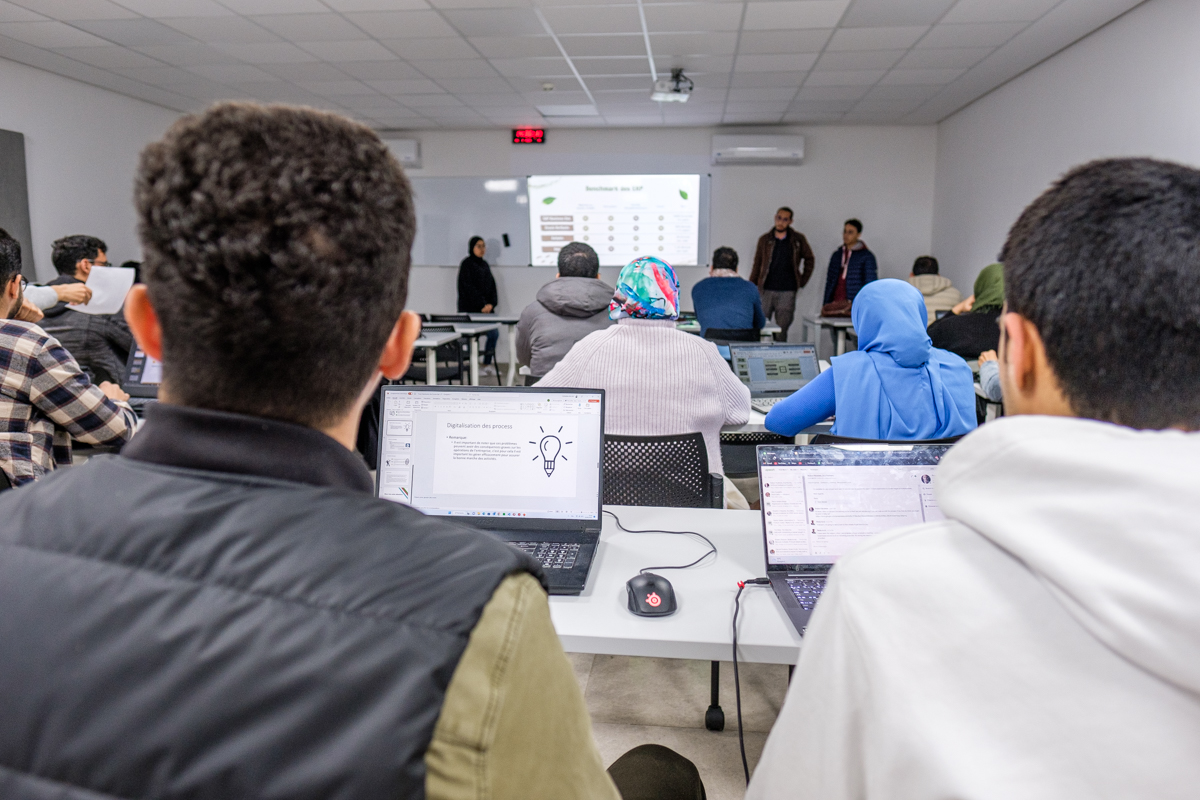
In terms of education, École Centrale Casablanca’s objective is to promote and support the development of students’ and teaching staff’s skills on sustainable development issues.
Conducted in collaboration with the teaching staff and the Academic Affairs Department, the analysis of the 2022-23 and 2023-24 engineering curriculum shows that:
- 11% of the total teaching hours in the engineering curriculum are dedicated to sustainable development topics in 2023-2024 (compared to 9% in 2022-2023).
- In 2023-2024, a total of 64 hours of courses integrating these topics are offered in the Core Curriculum (S5, S6, and common courses in S7) (compared to 18 hours in 2022-2023).
- In 2023-2024, two new specific courses on “Corporate Social Responsibility” and “Sustainable Development” were introduced in S7. Three elective courses are dedicated to environmental sustainability, social justice, the city of tomorrow with a responsible and sustainable approach, and risk management (political, economic, socio-cultural, psychosocial, technological, etc.).
- The “Entrepreneurship in Africa” track in S8 and the “Energy and Sustainable Development” option in S9 are focused on sustainable development.
- The 1st-year Learning by Doing project addresses sustainable development issues: “Energy & Environment” (2024-2025), “New Technologies for Education” (2023-24), “Smart and Sustainable Cities in Africa” (2022-23).
- A reflection is underway to identify a common foundation of SD&SR competencies and knowledge to be integrated across the entire educational offer (including internships, gap-year programs, and projects).
The actions carried out within the framework of the initial education contribute to the following Sustainable Development Goals:
For more information on other actions taken to raise students’ awareness of sustainable development issues, please refer to the SD&SR annual reports in the “Documentary Resources” section.
As part of its sustainability approach, École Centrale Casablanca aims to strengthen the integration of sustainable development issues into the school’s research and innovation strategy.
Analysis of the activities of the “Complex Systems and Interactions” Center for the years 2022-2023 and 2023-2024 shows that many research projects (academic projects or projects conducted in partnership with the socio-economic sector) are directly linked to the Sustainable Development Goals. Examples include the following projects:
- LISIAM Project (2023-2025): Conducted in partnership with Melint and funded by the industrial innovation support program “Tatwir-R&D and Innovation,” this project aims to develop an advanced remote monitoring solution using LIDAR networks and AI. It contributes to making cities safer and more sustainable by improving urban infrastructure management through high-precision detection and monitoring systems.
- ECOFRESH Project (2021-2025): A joint project with the LGI laboratory of CentraleSupélec focused on optimizing the supply chain of fresh and perishable products and studying the decarbonization of fresh product packaging and distribution processes to reduce CO2 emissions and food waste.
- MILEX Project (2022-2025): Study of urban mobility characteristics and last-mile logistics in emerging cities, aiming to identify key optimization issues related to urban logistics flows, model the decision-making problems involved in their management, and design effective solution techniques for the identified optimization problems.
- DIFIAIRE Project (2024-2026): A joint project created between an Inria team (French National Institute for Research in Digital Science and Technology) and a research team from ECC. DIFIAIRE focuses on infectious disease prevention through a multi-scale approach combining crowd dynamics and immuno-epidemiology.
- CNRS BAS CARBONE Project (2024-2026): Collaboration with Centrale Nantes on “Sustainable Development and Ethics: Training for the Low-Carbon Transition (DEFORM)” aimed at valorizing the research activities of the Institute of Civil and Mechanical Engineering (GEM) in the low-carbon transition, and more broadly identifying the ethical issues related to research activities.
Other key figures:
- In 2024, 44% of publications by ECC faculty members were directly related to the Sustainable Development Goals (compared to 15% in 2023).
- In 2024, 66% of scientific events organized at ECC were open to the general public (compared to 25% in 2023), thus allowing a wider dissemination of research and innovation results.
The research activities conducted at the “Complex Systems and Interactions” Center contribute to the following Sustainable Development Goals:
For more information on other actions taken to raise students’ awareness of sustainable development issues, please refer to the SD&SR annual reports in the “Documentary Resources” section.
As part of its sustainability policy, École Centrale Casablanca aims to minimize the environmental impact of its teaching and research activities.
In 2023, ECC conducted a partial carbon footprint assessment covering Scopes 1 and 2.
- Scope 1 includes all direct greenhouse gas emissions from the School (heating in buildings, emissions from owned vehicles, etc.).
- Scope 2 covers indirect emissions associated with the energy purchased by the School.
Conducted by Exprom Facilities, the analysis focused on three key factors related to the operation of the ECC campus (academic buildings and residence): electricity consumption of the buildings and their uses; losses of refrigerant gases from site installations; fuel and gas consumption.
The environmental footprint of the campus is estimated at 804.7 tons CO₂ equivalent, with electricity consumption accounting for 95% of the total greenhouse gas emissions calculated.
The actions carried out by ECC in the framework of environmental management contribute to the following Sustainable Development Goals:
For more information on other actions taken to raise students’ awareness of sustainable development issues, please refer to the SD&SR annual reports in the “Documentary Resources” section.
As part of its sustainability and social responsibility approach, École Centrale Casablanca aims to strengthen its social policy on equality and diversity for students and staff, and to develop a quality-of-life policy on campus.
Since its founding, ECC has sought to ensure access to quality education for all. Since 2015, more than 1,000 students have benefited from tuition and housing fee exemptions (reduced fees or full waivers during the first three semesters of the engineering curriculum).
More than 350 students have also received living allowances, enabling them to pursue their studies in a supportive environment.
This equal opportunity policy is a fundamental pillar of ECC’s sustainable development and social responsibility approach.
Other key figures:
- 33% of students enrolled in initial training are women
- 14 nationalities represented on campus
- 47% of ECC staff members are women
The actions carried out by ECC in terms of social policy for students and staff contribute to the following Sustainable Development Goals:
For more information on other actions taken to raise students’ awareness of sustainable development issues, please refer to the SD&SR annual reports in the “Documentary Resources” section.