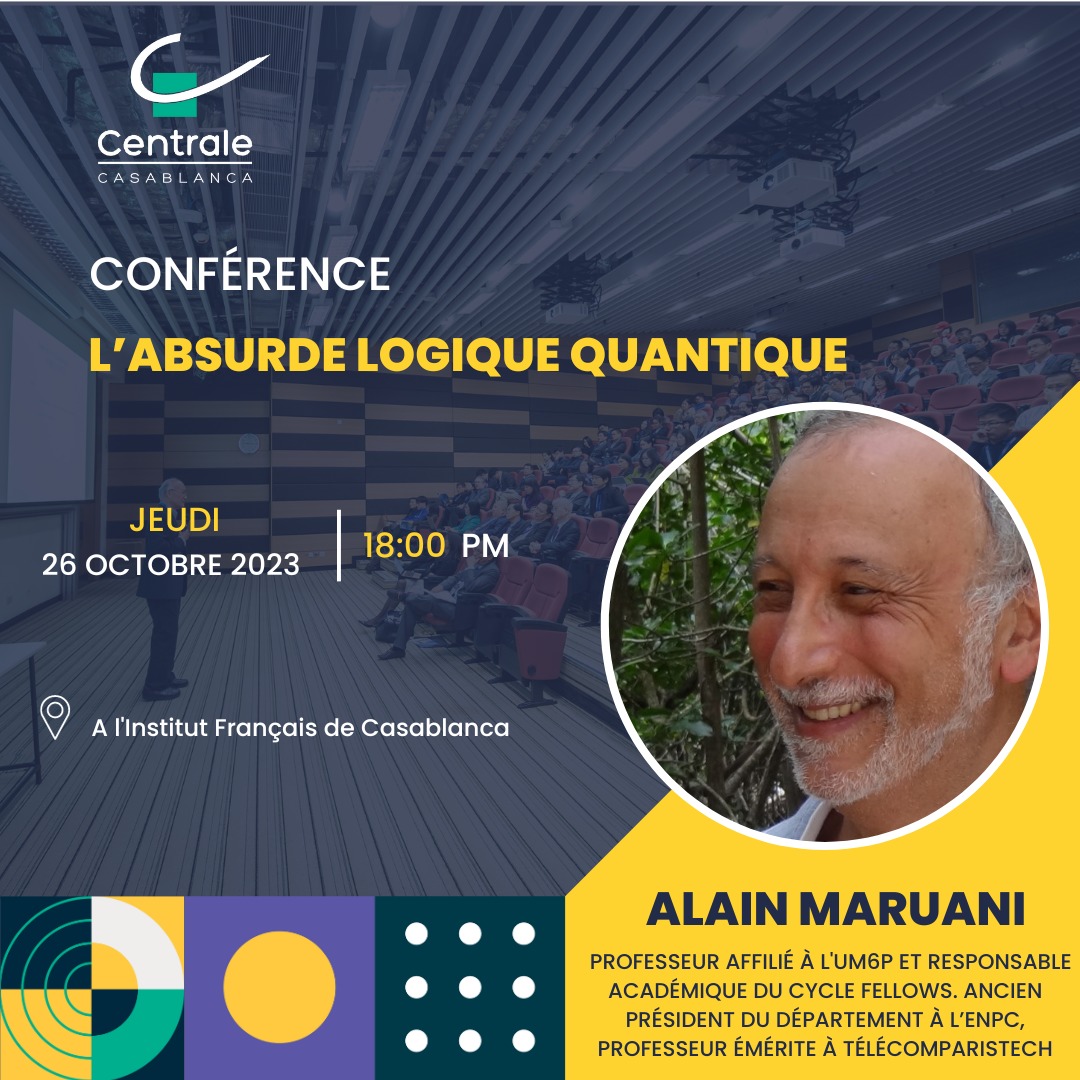
Presentation:
Two walks through the same universe are proposed, along two different paths and for two likely different audiences: an audience for whom mathematical language, judiciously and sparingly sprinkled in, might serve as useful shortcuts in the discourse, and an audience firmly convinced that what is well conceived is clearly stated and that words alone are sufficient for an intelligible presentation. Really? The intricacies of mathematical language reveal properties of the quantum universe that are unexpected and deeply unsettling to common sense. The interpretations of this language by practitioners will be multiple, contradictory, sometimes shocking, and spanning the entire range between extreme idealism and rigorous materialism. Quantum physics, carrying with it questions about time, space, causality, and our representations of the world, shaking our certainties and our intuitions, will relentlessly confront us with an unavoidable metaphysics. At the same time, the mathematical tools and technologies associated with this mechanics are triumphantly embedded in everyday life: we are never more than a few centimeters away from an object whose functioning or state relies on quantum principles. Some of these achievements will be presented, at an equal and respectful distance from elementary particles and cosmology; these stops will concern quantum physics in everyday life. A mixed discipline is developing vigorously: quantum cryptography and quantum computing, both grounded in phenomena that are fundamentally paradoxical to common sense — entanglement and its adversary, decoherence. Thousands of people, supported annually by billions of monetary units, dedicate their professional lives to a technological, scientific, economic, and financial avenue that widens day by day. If we agree that general culture includes scientific culture, then we must venture a glance in that direction; we will endeavor to do so. Along the way, it will be a lesson in humility — common sense and good sense can find themselves in a state of irreducible contradiction.
Alain Maruani
Alain Maruani is an Associate Professor at UM6P, Emeritus Professor at Institut Mines Télécom, and former department head at École des Ponts ParisTech.
His experience in research, teaching, and collaboration with French and foreign laboratories as well as with companies is extensive and diverse. He has been deeply involved in the organization of education in France, and particularly within the Grandes Écoles system — he was part of the founding team of the TIPE initiative and is the author of more than 180 problems set in various entrance examinations.
His publications (books and articles) cover applied and theoretical physics (biexcitonic multi-resonances in nonlinear optics), mathematics (Markov fields, theory of phase transitions in cellular automata), technology (thermal and optical processing and characterization of semiconductors), optical information processing (conoscopic holography), physiology (sensorimotor systems), and psychiatry (models of the psyche, critical states).
He founded a company based on his patents and has assisted students in creating start-ups (radar interferometry, etc.).
He holds the rank of Commandeur des Palmes Académiques.